 fabian s. klinke
Observing the Changes in Female and Male Vocal Ranges in Popular Music Over Time
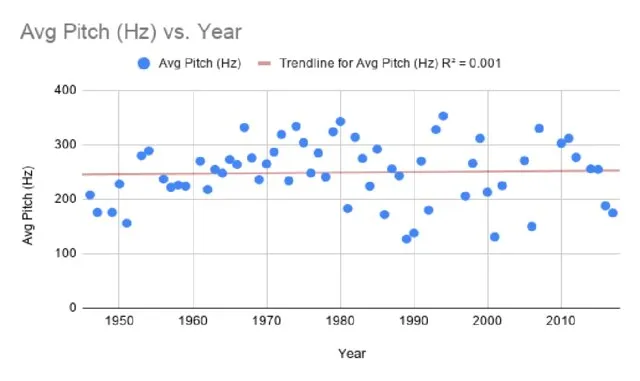
1. Relevance
-
music has become less male and more bright, even though gender bias study suggests that there are still more men than women (Interiano et al., 2018)
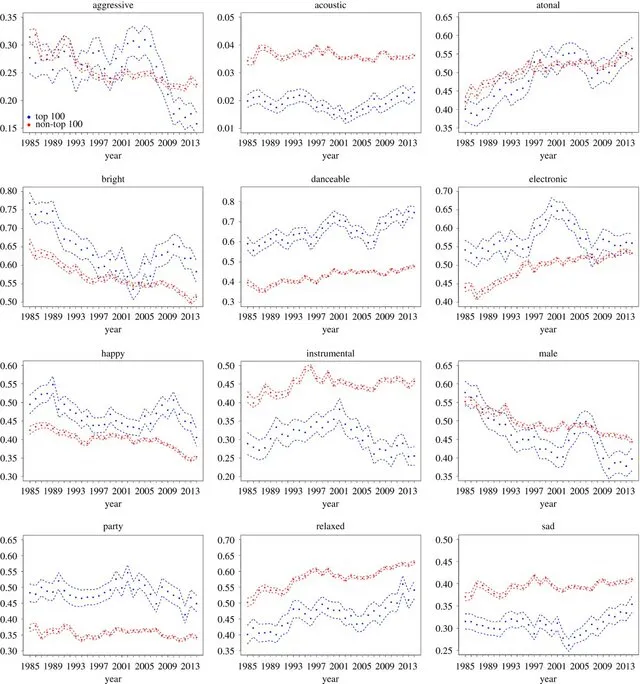
-
vocal ranges on average (without gender) stayed the same even though they diverged more (Ali et al., 2020)
-
changes in speaking voice:
- womens voices have become lower (Pemberton et al., 1998)
- more dominant men talk in lower voice (Puts et al., 2006)
- changes in gender traits: women get more masculine, while men appear to not have changed (by 1997) -> what is the case right now in 2024 (Twenge, 1997)
2. Methods / Sample
- (Hamilton et al., 2024)
- mhollingshead/billboard-hot-100: JSON files for every Billboard Hot 100 chart in history, updated daily.
- get metadata from spotify -> maybe also gather audio features just for the fun of it
- download from youtube
- separate voice from rest facebookresearch/demucs: Code for the paper Hybrid Spectrogram and Waveform Source Separation
- pitch detection:
3. Quelle Von Julie
Stefan Horlacher, Hrsg. „Wann ist die Frau eine Frau?“ „Wann ist der Mann ein Mann?“ Konstruktionen von Geschlechtlichkeit von der Antike bis ins 21. Jahrhundert. In: Zeitschrift für Anglistik und Amerikanistik, ZAA Monograph Series Band 10. Würzburg: Königshausen & Neumann 2010. 289 Seiten, EUR 39,80 [7]
Der interdisziplinär angelegte Sammelband: „Wann ist die Frau eine Frau?“ „Wann ist der Mann ein Mann?“ offenbart dem Leser anhand von zwölf Beiträgen aus Anglistik, Germanistik, Kulturwissenschaft, Klassischer Philologie, Musikwissenschaft, Geschichtswissenschaft, Soziologie sowie Männer- und Geschlechterforschung eine eindrucksvolle Vielfalt von „Konstruktionen von Geschlechtlichkeit von der Antike bis ins 21. Jahrhundert.“ Ausgangspunkt und Erkenntnisanliegen des größtenteils kulturhistorischen Sammelbands stellt das zunehmend zu beobachtende Verschwimmen der Geschlechtergrenzen in den westlichen Industriestaaten der letzten Jahrzehnte des 20. Jahrhunderts dar. Das vermeintlich starke Geschlecht verfällt im heutigen, mediendemokratischen Alltag zum besorgten Familienvater, der im gesellschaftlichen Selbstverständnis hin und hergerissen wird zwischen Männlichkeitsidealen wie dem epikureischen Marlboro Man, John Rambo oder stählernen Gestalten wie dem virilen Androiden aus James Camerons Terminator. Die Kehrseite zur martialisch-archaischen Männerutopie jedoch ziert ein völlig anderes Ideal; die Frauenwelt wünscht sich Softi-Typen aus Filmen wie „Der Bewegte Mann“ oder „Männer“. „In einer Gesellschaft des Spektakels (Guy Debord) und des Obszönen (Jean Baudrillard) geben sich ‚Machos‘ und ‚Softies‘ die Klinke in die Hand (…)“ (S. 8). Auch verdeutlicht die Prominenz metrosexueller Männer, wie etwa eines androgynen David Bowie, Boy George oder des inzwischen verstorbenen Michael Jackson, die gegenwärtige Konzeptionsvielfalt und gesellschaftliche Liberalisierung des Mannes.
4. Compute Cost
If the G5.2xlarge feels overpowered, let’s look at a less powerful but still reasonably comparable instance. Here’s a more balanced alternative:
4.1. Suggested EC2 Instance: G4dn.2xlarge
- CPU: 8 vCPUs (comparable to the M1 Max).
- GPU: NVIDIA T4 GPU (closer in performance to the M1 Max GPU).
- RAM: 32 GB (adequate for balanced CPU/GPU tasks).
- Storage: EBS-optimized, with separate storage costs.
4.2. Instance Cost
- G4dn.2xlarge: Priced around $0.752 per hour on-demand.
- Storage Cost: 500 GB of General Purpose SSD (gp3) is approximately $0.08 per GB per month.
4.3. Cost Calculation
- Instance Cost:
1800 hours * $0.752/hour = $1,353.60
- Storage Cost:
- 500 GB for 1 month:
500 GB * $0.08/GB = $40
Total Estimated Cost
~$1,393.60 for 1800 hours of usage at 80% CPU/GPU usage, with 500 GB of storage included.
This instance provides a more balanced comparison to the M1 Max without being overly powerful, offering a similar CPU and GPU combination with sufficient RAM and the required storage.